
Science & Technology
Stone-like strength. A fraction of the carbon.
Cement is responsible for around 8% of global CO₂ emissions. Most of that is locked into its chemistry. We avoid this problem entirely.
The problem with cement.
Portland cement is made by heating limestone in a kiln to around 1,450 °C. Burning the fuel releases CO₂, but most of the emissions come from the limestone itself, which gives off CO₂ as it turns into clinker.
That is why cleaner energy alone can't fix cement. The chemistry has to change.
- ~850 kg
- CO₂e per tonne of Portland cement
- ~60%
- of that comes from the limestone, not the fuel
- 1,450 °C
- kiln temperature needed to make clinker
What is a geopolymer?
A geopolymer is a mineral binder that sets into a hard, stone-like network without any Portland cement. Instead of burning limestone, it uses a clay-based powder and an alkaline solution that bind together at ambient or low temperature.
Clay, not limestone
Our binder is based on metakaolin: clay that has been gently heated, at roughly half the temperature of a cement kiln. No limestone, so no limestone CO₂.
Activate
An alkaline activator unlocks the clay and starts the reaction that links it into a dense, three-dimensional mineral structure.
Cure, don't fire
Products are cast and cured at ambient or low temperature. There is no firing step for the finished tile.
Why clay? Many geopolymers rely on fly ash or slag, by-products of coal power and steelmaking. Those supplies are diminishing and vary from batch to batch. Clay is abundant and consistent, with a reliable global supply minimising international shipping.
How the routes compare.
There are several serious attempts to reduce the carbon content of cement. This is how their embodied carbon and energy use compare per tonne of binder.
- Portland cement (benchmark)850
- Alkali-activated natural pozzolans400
- 50% slag (GGBS) blend400
- Electric-kiln clinker300
- Lime + carbonation200
- Recycled cement paste200
- Fly ash / slag geopolymer172
- Lakeland Flowstone — pilot164
- Lakeland Flowstone — target76
- Electrochemical cement72
Pilot scale, binder incl. fine sand Target with planned process improvement
- Portland cement (benchmark)3.5
- Electrochemical cement3.0
- Lime + carbonation3.0
- 50% slag (GGBS) blend2.45
- Alkali-activated natural pozzolans2.0
- Electric-kiln clinker2.0
- Recycled cement paste2.0
- Fly ash / slag geopolymer1.5
- Lakeland Flowstone — reference mix1.28
Published data for the reference mix ours is based on
Decarbonisation isn't easy
Slag and fly ash are by-products of the energy-intensive steel and coal industries. Electric kilns cut the fuel emissions, but not the CO₂ released by the limestone itself. Electrochemical processes are capital-intensive and immature in development. Carbonation needs a CO₂ supply and controlled curing.
A smarter route to lower carbon
We limit our energy-intensive processing to the electricity used to make the alkaline activator. As the national grid gets cleaner, so does our process.
Performance is not a trade-off
Typical Portland cement concrete reaches approximately 40 MPa in strength. We target more than 50 MPa.
“Reducing construction industry emissions by the extent necessary to limit warming to 1.5 °C will require a huge increase in the use of alternative cements and a shift away from Portland clinker, GGBS and fly ash, in addition to lowering the overall demand for cement where possible.”
Built to resist acid.
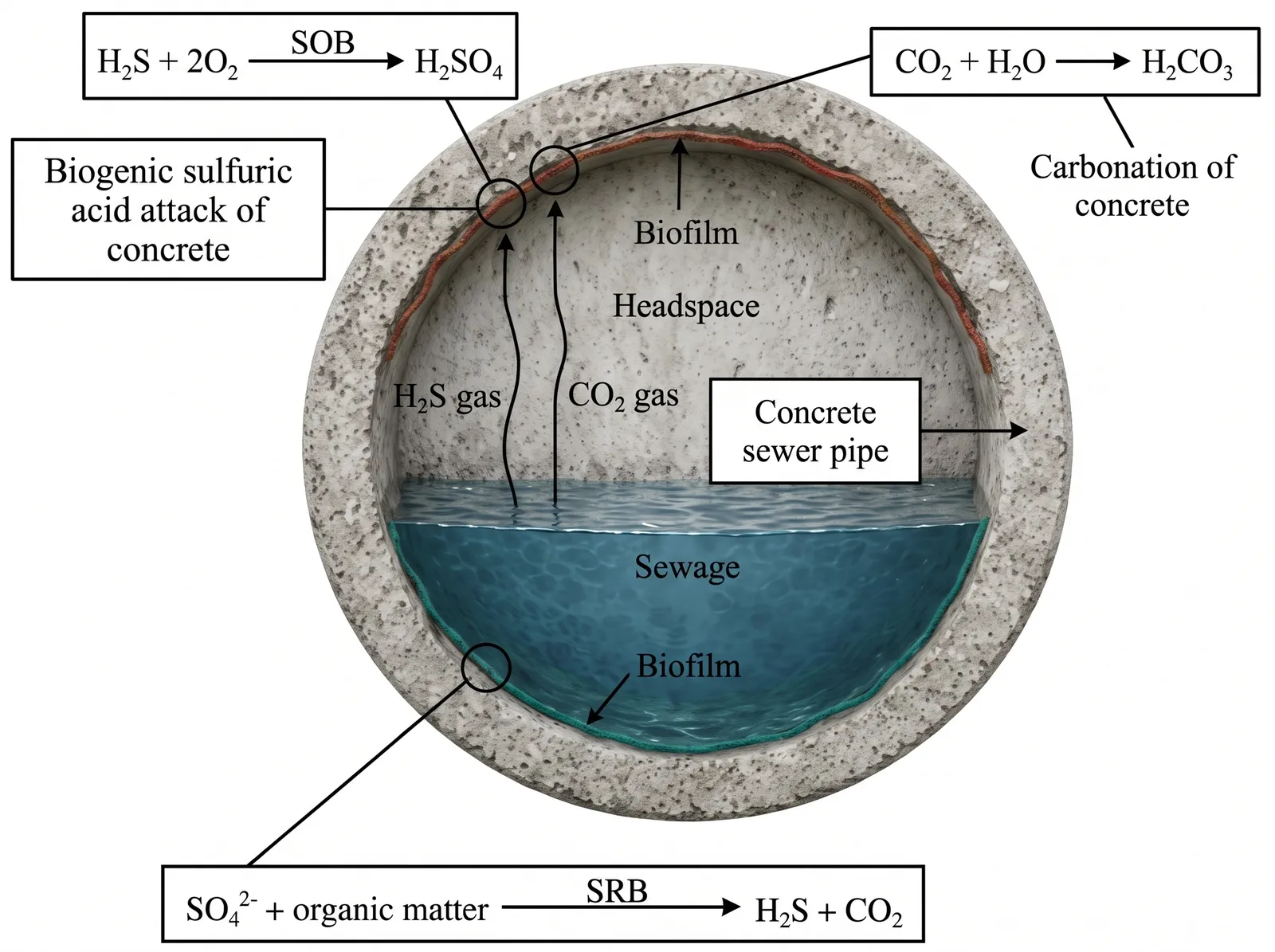
Concrete doesn't only fail under load. In sewers, bacteria turn sewage gases into sulphuric acid, which eats Portland cement away from the inside. Engineers call it probably “the most common and most severe” way microbes damage concrete.1
~$10 billiona year in reported damage from this kind of acid attack, in the United States alone.1
 Open full size
Sewage gives off gas
In slow-moving sewage, bacteria break down sulphates and release hydrogen sulphide, the gas behind the rotten-egg smell.
The gas becomes acid
Other bacteria living on the damp pipe roof turn that gas into sulphuric acid, often at 10% strength or more.2 Measured acidity on affected concrete reaches about pH 2.1
The acid eats the cement
Portland cement is alkaline and rich in calcium, so the acid dissolves it.2 One 100-year-old tunnel lost its concrete surface and its first layer of steel reinforcement.1
Geopolymer concrete holds up.
Researchers made sewer pipes from both materials and tested them side by side, in a live sewer test chamber and in strong acid.2
- Portland cement concrete pipe39.6%
- Geopolymer concrete pipe4.3%
Source: Gourley and Johnson,2 Table 3. Average of the pipe samples tested in SA Water's sewer test chamber in Adelaide, Australia.
- 8–9×
- slower corrosion than equivalent Portland cement concrete in the sewer test chamber
- <3% vs 100%
- mass lost after 50 days of repeated soaking in 10% sulphuric acid: geopolymer vs Portland cement concrete
- 10 years
- in service in an Australian sewer, with no obvious signs of corrosion on camera inspection
“Being an alumino-silicate glass matrix, it clearly has superior acid resistance properties to that of the conventional calcium silicate hydrate matrix found in OPC concrete.”
Why it matters to us. Our tiles are made with a geopolymer binder too. It sets into a stone-like mineral network, with no Portland cement for acid to eat away. That's part of what we mean by built to last.
164
kg CO₂e per tonne of binder, including fine sand, at pilot scale today
76
kg CO₂e per tonne targeted with one planned process change
50+
MPa target strength class
About these numbers.
- All figures are per tonne of binder, not per finished product, and are indicative midpoints of published ranges (Portland cement is commonly quoted at 850–920 kg).
- Results for alkali-activated and geopolymer binders depend heavily on how the activator is made.
- All values change with the carbon intensity of the electricity used and with the accounting method.
- Our binder includes the fine sand that takes part in the reaction; the other routes are quoted as binder only, so the comparison is indicative.
- Lakeland Flowstone carbon figures are pilot-scale company data. Our energy figure is published data for the reference geopolymer mix our formulation is based on, not yet measured on our own process. Verification and a full Environmental Product Declaration (EPD) are part of our planned certification route.
- The acid-resistance results are for geopolymer concrete sewer pipes made with low-calcium fly ash, not for our clay-based tiles. The authors note that geopolymers made with other binders may perform differently. Their test chamber was dosed with 40–50 ppm of hydrogen sulphide, several times the 5–10 ppm typical of a city sewer, to speed up the attack.
Sources.
- H. Hou, K. A. Steiner, J. Fraczek and J. A. Mahaney, “Biogenic Sulfuric Acid Attack and Case Studies”, Concrete International, American Concrete Institute, May 2020, pp. 33–38.
- J. T. Gourley and G. B. Johnson, “The Corrosion Resistance of Geopolymer Concrete Sewer Pipe”, Concrete in Australia, Vol. 43 No. 1, 2017, pp. 39–44.